Stop the presses! Stop the presses! No wait – START the presses!
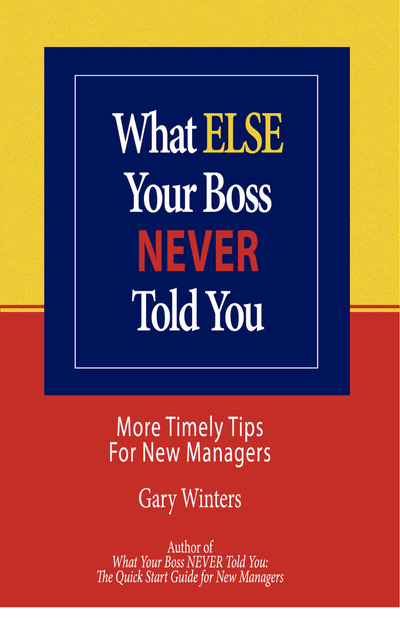
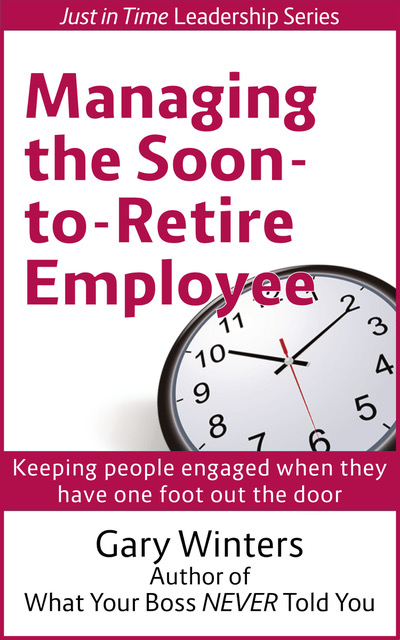
My newest ebook, Managing the Soon To Retire Employee has just been released and is available on amazon.com. It’s filled with tips, insight, and practical solutions to issues that can arise when you manage people who are approaching retirement.
Highly effective managers vary their approach and use different techniques with various subsets of employees. A style that might work well with seasoned veterans could be highly ineffective with a group of new hires. One group that has received little attention, from a manager’s perspective, is people I call Sooners.
These are folks who are three years or less from full retirement. As a group, they share some critical characteristics:
They are likely to be older than most of their peers and perhaps their boss.
They are in the midst of a major transition – from employee to retiree.
They face the unique challenge of staying focused on their job while looking ahead to the time when they will no longer be working.
They may be overwhelmed with anxiety, a sense of isolation, nostalgia, positive anticipation or negative reluctance, burnout, etc.
They may face stereotyping (such as being seen as resistant to change or aloof or self-absorbed)
Managing the Soon To Retire Employee is an ebook you can read in an hour or so. You’ll learn just what it’s like to be a Sooner, the three stages of transition, why some Sooners become problem employees while others become outstanding contributors – and what you can do to facilitate a positive experience in their remaining months and years. You’ll read an Open Letter from a real-life Sooner which makes a compelling case for managers to adjust their approach to better lead Sooners.
This may be the first book of its kind – with a focus on equipping managers with the tools they need to get good performance from their Sooners while “being there” for them in terms of helping them prepare for retirement. If you have Sooners on your staff, you should check this one out.
I began blogging an alphabet collection of ideas on April 1st as a response to a suggestion from Arlee Bird on the blog Tossing It Out.
I managed to get to the letter “I” before other priorities in life, such as finishing and submitting the final manuscript for my latest book, Managing the Soon To Retire Employee) overtook me, and I set the alphabet posts aside.
I skipped everything from “J” to “Q,” and realized today should be “R” day. I can only wonder what I would have written about during that interval had I had the time.
Now, we’ll never know.
Perhaps I would have had an insight so bold, so brilliant, that it would have changed the practice of leadership forever.
Then again, perhaps not.
What I’m realizing this morning is that all I have is the present – what’s passed is past, and what lies ahead remains unknown. And author Terri Guillemets reminds us not to “let the past steal our present.”
With that in mind, I’m letting go of feeling any angst, disappointment, or even curiousity about what I would have done with J-Q. I’m betting you, too, didn’t get everything done you had in mind from April 12-19th.
Let’s all take a deep breath and let it go.
Today, I have R.
R is for resilience, response, reaction, rehabilitation, rebound, and revolution. It’s for repeat, and renege, and reiterate, not to mention review, revoke and reveal. It’s also about renew, and that’s what I propose to do with the A-Z suggestion.
I’m renewing my commitment to completing the challenge. I’m already wondering what will emerge when I consider S, tomorrow.
But that’s for the future to reveal. Today, I’m going to enjoy the now.
This article is part of a series of 26 posts for the month of April called “Blogging from A to Z,” an idea first suggested by Arlee Bird ofTossing It Out.
Take a moment, if you will. Breathe deeply and hold your breath for a few moments, and then slowly release it. Repeat twice more, so that you are completely relaxed.
Now, imagine a day at work, visualizing you and your team. Now take it up a notch – imagine a perfect day at work. A day where everything goes right and nothing goes wrong.
Imagine how it begins, with people arriving, greeting one another, heading to their desks. Hear their greetings. What do you notice about them?
Imagine everything gathering for a quick meeting. See them come together and take their seats. Imagine you welcoming them to the meeting. Notice their reactions and expressions. Remember, this is a day when everything goes right and nothing goes wrong.
Imagine you leading the meeting. Imagine people becoming engaged in the dialogue. Imagine ideas being put forth, and people reacting to those ideas with enthusiasm. Imagine the group tackling a particularly thorny problem that’s been on everyone’s mind for some time now.
Imagine a creative solution being proposed, and imagine it is offered by the person you would have thought the least likely source for that idea. Imagine the group embracing the idea and realizing it is the ideal solution for the problem.
Imagine that!
A meeting where everything goes right, and nothing goes wrong.
Imagine people leaving the meeting and returning to their individual stations. Imagine you going through your email and inbox and organizing the rest of your day. Everything goes right, and nothing goes wrong.
Imagine working throughout the morning on important tasks. Imagine making enormous progress on the most critical. Imagine calling people and having fruitful, engaging conversations. Imagine being interrupted, from time to time, and seeing those interruptions as a normal, expected part of your flow.
Imagine having lunch with a close colleague, and coming back feeling refreshed, relaxed and ready to take on the afternoon.
Imagine having several brief meetings with members of your staff, catching up on their progress on their progress. Imagine yourself offering useful suggestions and taking a moment to recognize their accomplishments with them. Imagine them leaving your office filled with satisfaction for having stopped by.
Imagine your boss calling you with major concerns about a looming deadline. Imagine letting the boss know that everything’s coming together beautifully, and there is no reason for worry. Imagine your boss accepting your input gratefully.
Imagine realizing the end of the work day is approaching, and everything you had hoped to accomplish today is just about finished. Imagine taking out a pen and jotting a few things down on your To Do List for tomorrow.
Imagine gathering your things and striding for the exit, greeting those employees who are still there, each finishing up something before heading home.
Imagine a day where everything goes right, and nothing goes wrong.
Tomorrow, do it again, and the next day, again. Learn to imagine a day where everything goes right, and nothing goes wrong in sixty seconds.
Practice imagining that day without a little voice in the back of your head that says, “Yeah, but…”
Imagine a day where everything goes right, and nothing goes wrong for the next thirty days, just as an experiment.
Imagine what might happen.
This article is part of a series of 26 posts for the month of April called “Blogging from A to Z,” an idea first suggested by Arlee Bird ofTossing It Out.
One common denominator in the most effective leaders I know is that they have a well-developed sense of humor.
They’re not comedians, they rarely tell structured jokes, but they can lift a group in a heartbeat with a well-placed one-liner – which is often a self-deprecating piece of wit.
They know the importance and how to use humor to cut tension and help people start to believe that there just might be a way through a crisis.
Years ago I was convinced my career was stalled – and that it was likely to stay that way. My boss took an interest in my struggles for some reason, and as we sat down to talk, he said, “Don’t worry, kid. If you’ll work hard eight hours a day, eventually you’ll get to be boss and work hard twelve hours a day!”
His line brought a smile to my lips and I remember relaxing and feeling a little better immediately.
Today, as I think about talking about the intersection of leadership and humor, I remember something E. B. White, author of the classic Charlotte’s Web, said. “Analyzing humor,” he warned, “is like dissecting a frog. Few people are interested, and the frog dies of it.”
Okay, I get it.
But if you’re reading this far, maybe you are interested, and I promise – no frogs were harmed in the creation of this blog post.
Tension was in the air that day, as over 100 middle and senior managers gathered in a hotel ballroom for a critical meeting. The company was at a threshold. It was fast approaching $100 million in annual sales, a significant milestone, but there was growing concern it had not developed the systems and people to continue to thrive. People worried that it had grown too much and too fast. This meeting was widely seen as a make-or-break event.
I had been asked to facilitate the meeting, which mostly meant introducing speakers and keeping track of time. I was on the dais getting nervous because the President of the Company, Jim, who was scheduled to speak next, was nowhere to be found.
The current speaker was droning on about some sobering statistics with the crowd and I couldn’t think of much of a Plan B if Jim was delayed any further. I got ready to tell the group to take a quick break to stall a few more minutes.
Then, just as the speaker brought his presentation to a close, a door to the ballroom flung open, and into the room strode, with great fanfare, a costumed character – Mickey Mouse.
This was not on the agenda, I thought. What was going on?
“Mickey” strode to the front of the room, making lots of noise along the way and getting the full attention of the group. He sashayed up to the dais, took the microphone, and appeared to be getting ready to speak.
But for several long seconds he said nothing. All eyes were on him. The tension rose. Who was he and why was he interrupting the meeting? Was he some sort of protestor or agitator?
Then he removed his headpiece. Inside the costume was none other than Jim, the company President.
“Good morning,” he said. “For those of you who don’t know me, my name’s Jim, and I’m the President of this Mickey Mouse outfit!”
The stunned audience began to laugh. It got bigger than that. They guffawed. The tension had been broken. Jim went on to spend about twenty minutes talking with the leaders of his organization, telling them why he was optimistic that they would find solutions to the critical issues facing the organization.
He was right. They did.
Bill Cosby has said, “You can turn painful situations around with laughter. If you can find humor in something, you can survive it.”
“I think the next best thing to solving a problem is finding some humor in it,” is how Frank A. Clark (creator of “The Country Parson,” a syndicated newspaper cartoon) put it.
Even Harry S Truman had an observation about leadership and humor: “Any man who has had the job I’ve had and didn’t have a sense of humor wouldn’t still be here.”
If you’re in a leadership role, don’t be reluctant to use humor from time to time to help people through a rough patch. Far from being inappropriate, it may indeed be the best medicine.
And for those of you who don’t think of yourselves as having a good sense of humor, at least take W. C. Fields’ advice: “Start every day with a smile and get it over with.”
This article is part of a series of 26 posts for the month of April called “Blogging from A to Z,” an idea first suggested by Arlee Bird ofTossing It Out.
You see it all the time. That draft of the report is good enough. The presentation to staff was good enough. The error rate on product defects was good enough. The budget for that new project was good enough. The response time to customer emails is good enough.
What sustains the tension between “good enough” and “excellence” is that there simply isn’t enough time, money, or resources to move everything from good enough to great, but we want to do our best work. Right? We know we could improve our deliverables, whatever they are.
So how do you decide when good enough is good enough? When action is more important than improvement? Here’s three suggestions to keep in mind:
When a life is on the line.
While having an actual life on the line is pretty rare (thank goodness!) the point is this: when the need to act clearly supersedes the need to perfect whatever you’re working on, act.Remember Apollo 13? In the race against time to save the astronauts, engineers jerry-rigged an air filter made with duct tape. No doubt as engineers they would have liked to keep testing and improving their design, but urgency had to trump elegance.
When incremental improvements are becoming a hobby.
I recall studies down when desktop publishing became widely available that showed that productivity did not rise, as expected. It slowed down because people were endlessly tweaking their products – because they could. True, the bar of professionalism had been raised, and what was acceptable before (a typewritten newsletter, for example) was not acceptable now.
When you’ve crossed the 5 yard line.
If you’ve invested a big chunk of time and effort to create a solid draft of the report, or a beta website, or a working prototype, you’ve probably no more than five yards from the goal line of perfection. The problem is that the next five yards will probably require as much time and effort as what you’ve already expended.Maybe it’s time to publish the report, launch the website, or start producing the product. Rarely is it true that it can’t be improved afterwards.
I wrote my first book several years ago. Even today, I see ways of improving it. But if I’d waited until I’d exhausted all the possible improvements, I’d still be an unpublished author.
This article is part of a series of 26 posts for the month of April called “Blogging from A to Z,” an idea first suggested by Arlee Bird ofTossing It Out.